The trouble with jargon is that it is catching. We consciously (or unconsciously) echo this slanguage as if using certain hackneyed words or expressions is the only way to grab people’s attention and to allow us to speak with apparent authority on a particular issue.
The wine trade rejoices in its own gobbledegook, an unironic buzzword-ridden lexicon of banality that seems to proclaim by virtue of its very usage that the wine industry is hard-wired into professional practice. If it quacks like a professional, it must be a professional.
Let’s bust some jargon. God forbid that we ever think that wine is a beautiful beverage made from hand-plucked grapes grown in an idyllic vineyard and that we are the storytellers as well as the sellers of the product. There is too much emphasis on magic marketing, of each and every wine being seen as a brand that needs to be packaged in a particular way and sold to expectation.
The wine trade rejoices in its own gobbledegook, an unironic buzzword-ridden lexicon of banality that seems to proclaim by virtue of its very usage that the wine industry is hard-wired into professional practice. If it quacks like a professional, it must be a professional.
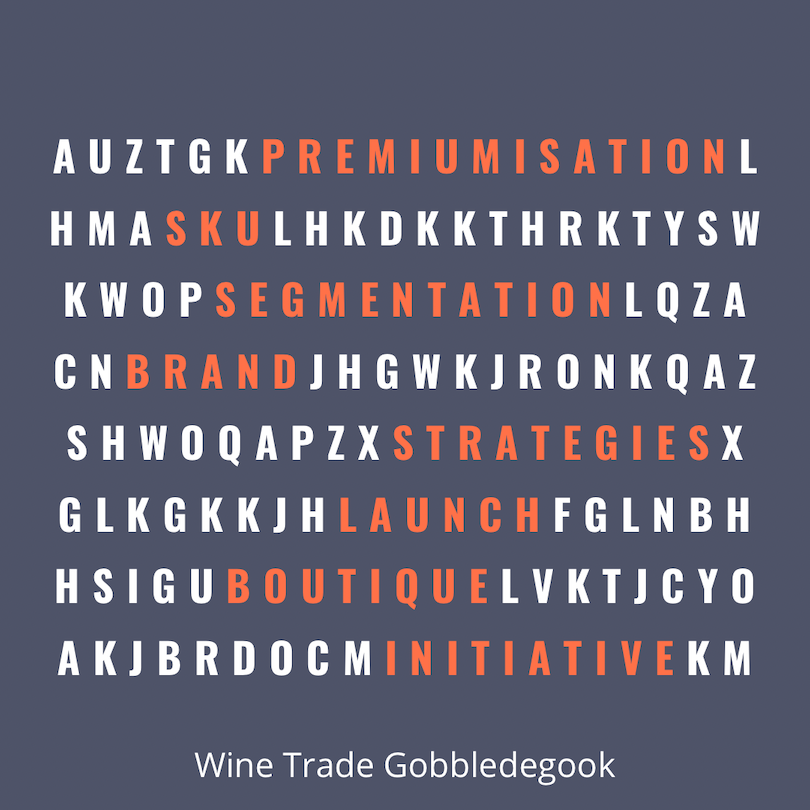
Probably, my favourite hate-word is premiumisation. It’s the -isation that sends me over the edge. It is the art/science of persuading people to spend more money on a bottle of wine by making that wine an aspirational product (another pet hate term). You want consumers to examine their choices, recognise extra quality, and consequently voluntarily choose to go up a rung on the wine spend ladder.
Segmentation in business is the process of dividing a broad market into smaller, more specific groups of customers based on shared characteristics like demographics, needs, or behaviours. This allows companies to create more effective marketing, product development, and sales strategies by tailoring their efforts to the unique preferences of each segment. Treating people like they are individuals? Whatever next? Marketing treats individuals as consumer units, views behaviour via algorithms. Surely, the wine is the wine is the wine, and the human being is a bundle of complex impulses, thoughts and feelings. I don’t want to wake up every day feeling as if I am a mere segment.
Strategies. Wine and PR companies constantly have meetings to explore their strategic options with the purpose of finding ways and means of obtaining greater recognition for – and selling – (more) products. The more one agonises about strategy, the further away one is from the wines themselves and the people who choose wine on its merits.
SKU – Pronounced skew. Eww! Short for stock keeping unit, a unique, alphanumeric code assigned by a company to a specific product for internal inventory management. These are wines, not numbers. “I am not a number, I am a free man!” shouted Patrick McGoohan at the beginning of each episode of The Prisoner. Wines are not numbers, not names evening, but compressed histories.
Brand (brand recognition) – It is almost impossible not to use the b word in everyday wine conversation. We do all in our power to dissociate ourselves from the term, yet without doubt, larger and more famous estates become de facto brands by virtue of their reputation. A branded product is normally a consistent one – certainly at the cheaper end, where supermarket shelves are largely populated by wines from companies that churn out the same labels, the same wines, year upon year.
God forbid that we ever think that wine is a beautiful beverage made from hand-plucked grapes grown in an idyllic vineyard and that we are the storytellers as well as the sellers of the product.
Boutique derives from the word for a small (usually specialist) shop, but has come to mean fashionable, exclusive and niche. In wine parlance, it might refer to a small-production wine made by artisan methods. In reality, boutique wines seem to mean any cuvees that are made at a higher-end price point and in lower quantities.
Launch, initiative – A marketing idea. Many initiatives involve giving pr companies money to plant stories in as many trade journals as possible to launch the product in question. In that sense, a product is launched when journalists/trade magazines give it the oxygen of publicity. The brand money is talking, but who is listening? High volume, relentless exposure surely does have an effect in terms of building recognition for a brand, but in the professional world of wine, any wine cannot rest on its laurels. It needs to be tasted, assessed – not just by journalists – but the very individuals who are in a position to buy it and sell it on.
Jargon is used in a more tongue-in-cheek way in the natural wine sphere. We talk of unicorns (wines so unobtainable that they have an almost mythic status) and bangers (wines that are very good indeed). We also use a lot of flip terms as shorthand for complex concepts. Language doesn’t have to be precise when talking about wine, particularly one’s personal impressions. One should call out the prevalence of frankly ugly terminology that depersonalises wine and treats it as a functional business product. Especially when that wine is a living product and a soulful thing and gives rise to moments of deep appreciation and pleasure.
*
Stay in the loop and never miss a tasting or jargon-free newsletter! Contact us to request to be added to our mailing list:
shop@lescaves.co.uk | sales@lescaves.co.uk | 01483 538820